by Astrocreativa.com
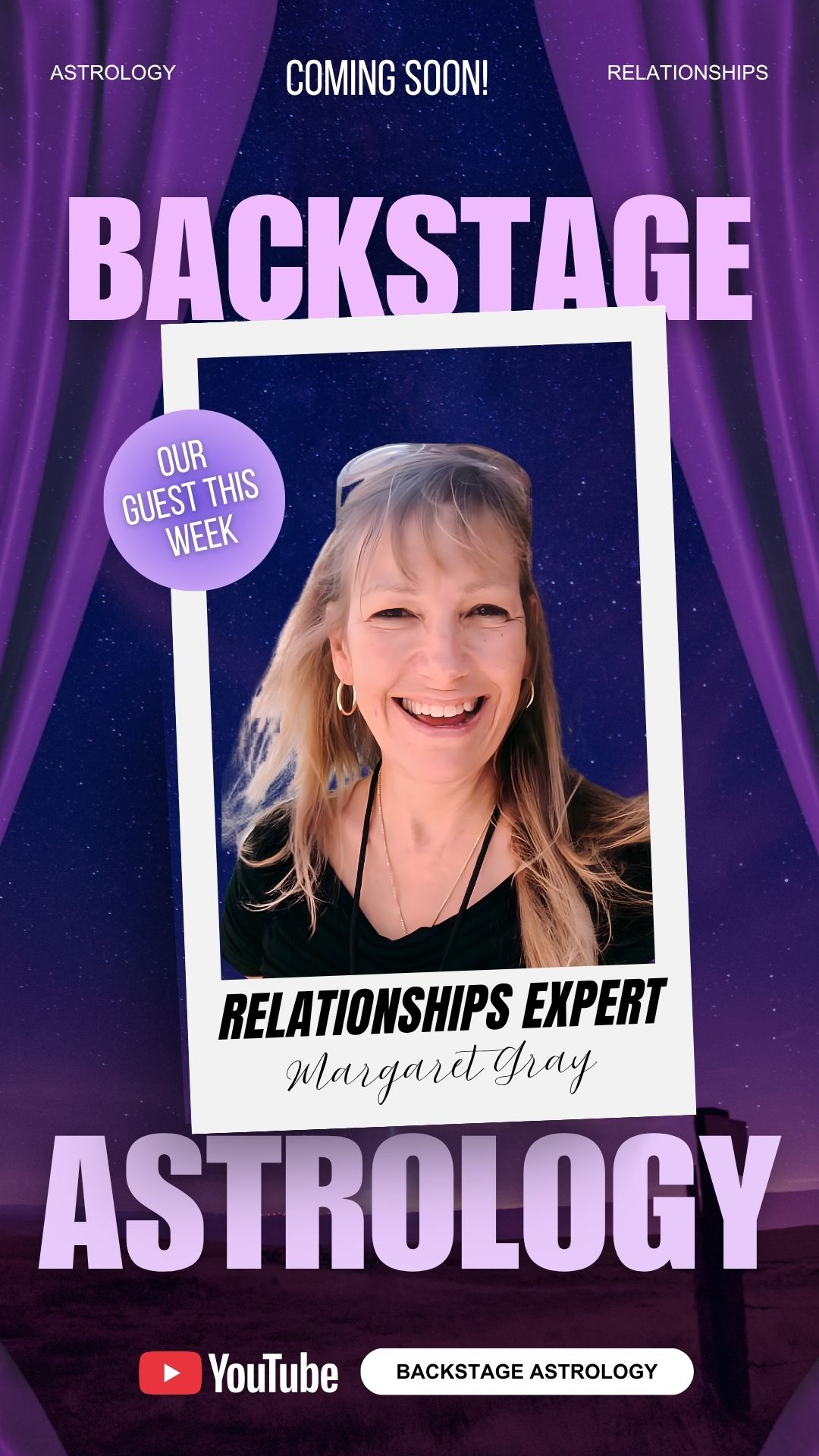
Director, Center for Relationships & Astrology, MSW., B.A Counseling and Psychotherapy
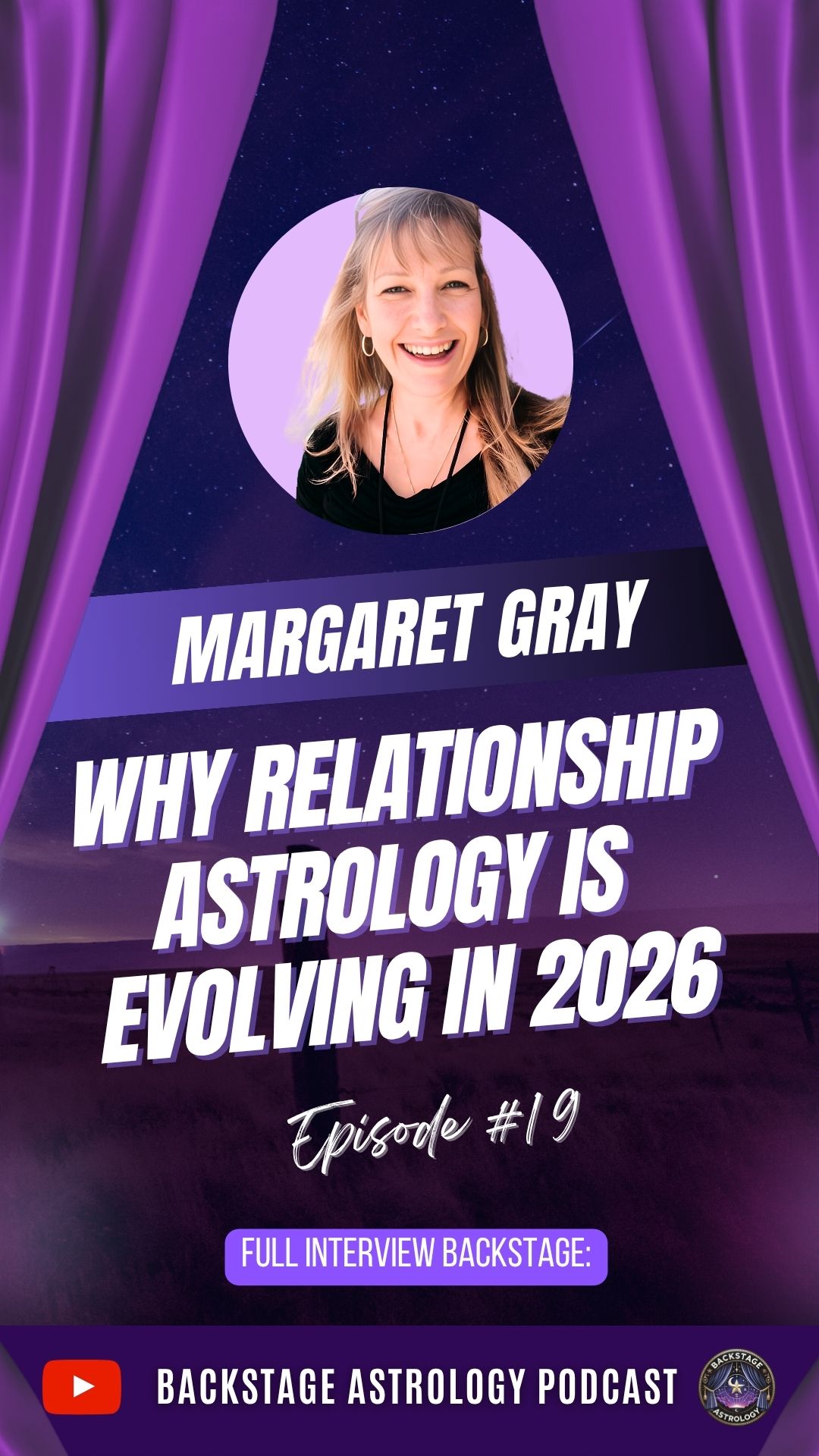
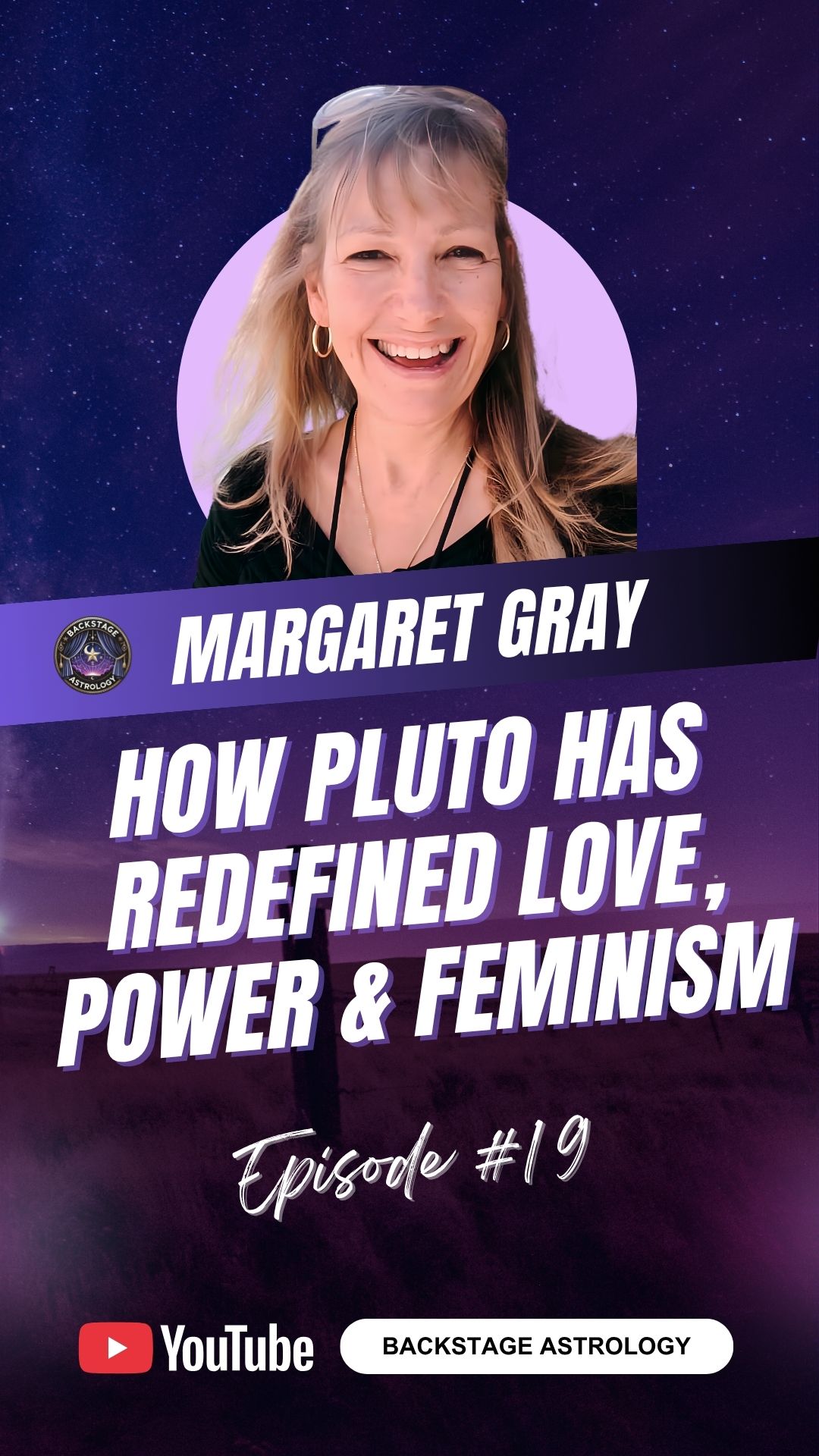
Margaret Gray (Aries Sun, Scorpio Moon, Virgo Rising), is an Ireland-based psychological relationship astrologer and psychotherapist (trained in clinical social work), known for weaving therapeutic relationship skills with deep astrological technique.
Born in Ireland to an Italian mother and Irish father, Margaret grew up bilingual (Italian first), then became a true “wanderer”—living and studying in the United States, working in the UK for 17 years, spending 10 years in Hawaii, and later returning to Ireland full circle.
Her astrology training includes psychological astrology study and advanced work through the CPA in London, including study with major figures in the field (as mentioned in the episode). Today she is the director of the Center for Relationships & Astrology, where she teaches relationship astrology as a craft, a language, and an ethical discipline.
Every episode leaves a trail of untold stories…...and I save them for the Backstagers Community.
Get a Full Pass and Become a Backstager!
I turn astrology into story and astrologers into humans…
🟣 Are you being real or just sharing knowledge?
🟣 Is your message truly felt?
🟣 ARE YOU CONVEYING THE RIGHT MESSAGE?
In this Backstage Astrology episode, host Mayra Medina sits down with Margaret Gray—Ireland-based psychological relationship astrologer and psychotherapist—to explore why relationship astrology is evolving in 2026, and what that means for compatibility, commitment, synastry, and composite charts in a world shaped by Pluto in Aquarius and the Saturn–Neptune shift into Aries.
If you’ve ever asked “Are we compatible?” She reframes compatibility as a question: compatibility for what? Friendship, companionship, intimacy, passion, shared goals? She explains why relationships always require work (and lovingly blames “Disney movies” for the fantasy that they shouldn’t).
Margaret breaks down the core tools of relationship astrology—synastry (chart-to-chart activation) and the composite chart (the relationship as its own entity)—and shares why composite dynamics often become louder once couples live together.
The episode goes deeper into generational and collective shifts: changes in equality, consent, and choice; the historical evolution of marriage from contract to love match (and sometimes back to contract for practical reasons); and the massive relational implications of a world moving from earth/water emphasis to fire/air emphasis.
She also offers a grounded warning: AI may “pretend” to have feelings, but it doesn’t—so we must protect real human connection, ethics, and embodiment.
Margaret’s approach is relationship astrology with a psychological lens:
Trust-first methodology (in both therapy and astrology): trust must form quickly in couple dynamics, or the work collapses.
“No guessing games” astrology: she emphasizes curiosity over certainty—ask, don’t assume.
Multiple relationship tools (beyond basic synastry): composite charts, progressed composite, relocated composite, and more.
Relational perspective on natal charts: she highlights that a planet (like the Sun) behaves differently when interpreted for daily life vs relational functioning.
Ethics and scope: Margaret draws a bright line between astrological consultation and psychotherapy/counseling, urging practitioners to know limits and refer out when needed.
Margaret’s path into astrology began the old-school way: hand-calculated charts before modern software, despite being “awful at maths.” Later, with her first computer and ephemeris program, she deepened her studies through evening classes in the UK and then formal training in London.
Her entry into relationship astrology specifically accelerated in Hawaii, through both professional collaboration and personal experience—especially after reviewing a relationship astrology book by her colleague Armand, then later experiencing her own breakup and recognizing how powerful these dynamics are when explored consciously.
That blend—therapy + psychological astrology + lived relationship experience—became her signature.
Relationship Astrology 2026: why it’s evolving now.
Compatibility: redefining the question and the goal.
Synastry vs Composite Chart (and why couples often ignore composite).
Trust as the first pillar in couple work.
Asking better questions: “I’m wondering…” as a professional technique.
Karmic relationships, soul families, and the limits of certainty.
Pluto through the signs & generational relationship priorities.
From Neptune-in-Pisces merging → Aries-era individuation → the goal of interdependence.
Embodiment vs online connection: the need for real closeness.
AI and relationships: fantasy intimacy vs real relational growth.
Ethics: astrology vs counseling/psychotherapy—scope, training, referrals.
Elements and relational mismatch (especially missing elements).
Reframing Venus/Moon archetypes & challenging gendered astrology models.
Teaching “Astrology of the Heart” and globalizing courses beyond English.
“The first thing is building trust… trust has to happen very fast.”
“Always, always pose things as questions… because the reality is we don’t know.”
“Relationship skills are transferable to everything in your life… the world needs these skills.”
Mentioned / Referenced in the Episode:
The Center for Relationships & Astrology — “Astrology of the Heart” certification program (4 steps).
Training references: CPA (Centre for Psychological Astrology), London (mentioned by Margaret).
Topic areas to explore further (based on the episode):
Synastry & composite chart methodology.
Progressed composite & relocated composite techniques.
Ethical guidelines for astrologers working with couples.
Relationship skills frameworks (communication, attachment, trust-building).
Mayra Medina, Your Host
Mayra is a Creative Consultant for Astrologers working at the intersection of communication, branding, and archetypal astrology. Mayra believes that what truly drives visibility and impact is a compelling story, strong visuals, clear purpose, and thoughtful strategy. Learn more about what she can do for you:
What I learned from Margaret impacted me more than I expected.
First… compatibility is not a verdict.
It’s a question.
And the real question is: Compatible for what?
That alone shifted something inside me.
Margaret reminded me that relationship astrology is not about predicting whether two people “make it” — it’s about understanding what is being built between them. Friendship? Passion? Growth? Healing? A shared project? A karmic lesson? The purpose matters.
What struck me deeply was her emphasis on trust.
Trust is not optional in relationship work — it is foundational.
And not just between partners, but between astrologer and client.
The way she approaches couples — by asking “I’m wondering…” instead of declaring truths — reminded me how powerful humility is in astrology. We are not here to guess. We are here to be curious.
Another moment that stayed with me was her clarity around ethics.
Knowing your limits.
Referring out.
Not pretending to be a therapist if you’re not.
In a time where AI is blurring lines and authority can be fabricated, this felt grounding and necessary.
And then… her reflection on 2026.
As we move from heavy earth and water cycles into fire and air — as Pluto settles into Aquarius — we are being asked to redefine how we relate. There’s a temptation toward independence at all costs. But Margaret offered something more mature:
Not codependence.
Not hyper-independence.
But interdependence.
That word stayed with me.
We need each other.
We need embodiment.
We need real human nervous systems — not just digital affirmation loops.
And maybe the most powerful reminder of all:
Relationship skills are life skills.
Not just for romance.
For friendship.
For community.
For the way we disagree.
For the way we build the future together.
This conversation didn’t just expand my understanding of relationship astrology.
It reminded me why it matters.
Because in the end, astrology is not about charts.
It’s about how we choose to show up with one another.
And that… feels more important than ever.
I love doing work with couples as a therapist and I love working with astrology with couples and I love
merging the two and I love having my desk covered in charts. People will say, you know, are we compatible? And of
course, what does that mean? Does it mean what does compatibility mean to you? Does it mean that you have an
intimate relationship? Does it mean you have a good friendship? Does it mean that you get on well as companions or as
friends? That depends on what people are looking for and it all depends where
people are at. You know, the kind of work we’re prepared to do in relationships in our 20s and 30s is
often very different than what we might be prepared to do in our 40s, 50s and 60s. You know, first of all, the first
thing is building trust. Whether I’m working therapeutically or or astrologically
and with couples, trust has to happen very fast. I mean Aries sun in the
eighth house, uh, Scorpio moon, conjunct, Neptune, and I’m Virgo ascendant.
What has been like the challenges or or the the gifts of of that combo?
Sure. I think it’s just such an odd mixture because the Virgo ascendant is
constantly like, you know, who do you think you are? You know, take a step back, be humble, all of that. Be of
service. and the Aries sun. I remember an astrologer years ago saying to me,
“You’re not behaving like an Aries. You’re behaving like a Capricorn.” And I’ve got Saturn square, my son. Saturn
and Capricorn square, my sun in the eighth house. People, you see, a lot of people don’t realize there are so many
tools with relationship astrology. There’s the progress composite chart. There’s the relocated composite chart.
There are so many. And that’s why you know the courses we do is because when
people study on their own they really tend to just get the basics which are
fabulous but also what they don’t realize is that even during the sinistry there needs to
be an understanding of the natal charts from a relational perspective
because how your son behaves in terms of daily life in your work and everything
is different to observing your Sun from a relational perspective.
[Music]
Okay, so welcome back to another backstage astrology episode. My name is
Mariam Medina and I’m thrilled to be here with astrologer Margaret Gray.
Margaret, thank you so much for being here. How are you today? Oh, I’m wonderful and thank you so much for
inviting me. It’s a joy to be here with you. Thank you. Likewise, Margaret, um, how would you
like people to to know you really? This is the question I always ask them first.
Well, that’s not a great question for a Scorpio person. It’s like
layers and layers in front. So, there’s the public me and there’s the private me. And I suppose the public me is the
psychological relationship astrologer, the psychotherapist. The private me, that’s different.
And and tell us a little bit about your background. Where are you from? Where’s your family from? Where are you based
located? Sure. I was born in Ireland, an Italian mother and Irish father. In days when
Italy was miles away, so when my mother moved here, she had to learn a new
language. she had to get used to being a foreigner in a different country that wasn’t used to foreigners. So, I grew up
really speaking Italian. That was my first language. So, I kind of was an outsider in Ireland. And when I went to
school, I had to learn English fluently. And then as an adult, I’ve become a
wanderer. So, I left Ireland in my 20s. I studied in the US, got my masters in
social work there, clinical work um as a therapist, came back to Ireland. Then I moved to the UK for about 17 years. Then
I moved from the UK to the US and I lived in Hawaii for about 10 years. One year in LA and then I came back to
Ireland. So now I’ve kind of come full circle and here I am back in my native
country of Ireland where I grew up. Amazing. Margaret. So tell us um how did
your journey into the astrology of relationships begin? Was there a
particular chart or client or personal experience that that sparked it or how
did it start? You know, it’s kind of interesting. I was a psychological astrologer. That was
my training. And as a psychotherapist, the two go well together. And it really
started more um when I was in Hawaii. My colleague and friend Armand who started
relationships and astrology with me originally sent me his book separating aspects to review. I was reviewing books
for the board at the time. So I used to get some of books and his book really struck me
particularly when I had my own breakup a few years later and I thought this is so
interesting all these dynamics and I was already working with couples and working with relationships. Then I met Armand at
a conference and we decided we would do some work together and it really started from that and I thought I really love
this. I I just love it because it’s so interesting and I I love doing work with
couples as a therapist and I love working with astrology with couples and I love merging the two and I love having
my desk covered in charts and I connections and it’s just fascinating.
And then what I also love, and I did I was talking a little bit on Instagram the other day about this, is that as
much as we prepare for relationships, we’ve got to be ready to put all of that aside because there is so much we don’t
know from the paper, it’s not until the couple or the trouble or the family or the whoever the relationship dynamic is
about are there in front of us that we can then start really understanding
what’s going on. So, I think that’s one of the kind of great fun things about it
that it’s an adventure and I’m an Aries, so I love adventure and newness and it’s so exciting because I don’t know until
they’re there in front of me and I start talking to them and asking questions. Wow. So, tell us more now that you
mentioned you’re a a Scorpio moon and an Aries Aries sun. What are your big three
or you know like positions on your natal chart? that you want to share?
Sure. I mean, Aries sun in the eighth house, uh, Scorpio moon conjunct Neptune
and I’m Virgo ascendant. So, so it’s quite a mixture.
So, yeah, it’s interesting mix mixture. So, can you tell us more about how you’ve navigated that mix? What has been
like the challenges or or the the gifts of of that combo?
Sure. I think it’s just such an odd mixture because the Virgo ascendant is
constantly like, you know, who do you think you are? You know, take a step back, be humble, all of that. Be of
service. And the Aries sun, I remember an astrologer years ago saying to me,
you’re not behaving like an Aries. You’re behaving like a Capricorn. And I’ve got Saturn square, my son. Saturn
and Capricorn square, my sun in the eighth house. So, of course, I’m not going to be an Aries out there. But if
I’m pushed or if I believe in a cause or if somebody hurts a friend, then I
become an Aries. Then I come out and I’m very much an Aries. So otherwise, it’s
not that easy for me to be fully an Aries. It’s like I see other Aries
friends and I’m like, “Oh, you’re a real Aries. I’m real Aries.” So yeah, but I’m
I have a very Plutonian chart, so I can be very Plutonian. And that’s really what people pick up. And the Pisces,
there’s a lot of Pisces in my chart, including the ruler, Mars, is in Pisces.
So, that kind of dissolves like a puddle on the floor in tears if I’m angry. And
it’s so frustrating because my Aries son is like, I’m really mad, but my my my
Mars in Pisces is there crying, and people are like, oh, poor thing. She’s upset. I’m not. No, I’m not upset. I’m
really mad. Yeah. Wow. So interesting. So I wanted to ask
you because you are I mean a relationship astrologer. Is there any position in your natal chart besides the
sun in the eighth house? You I think that you know that pulled you towards
you know this branch of astrology. What would you say? Yeah. I’ve got Venus in the seventh house. So I think that pretty much kind
of was really is the astrological defining factor and it’s part of a yach
so it’s a very powerful Venus there. Um so it I think that’s really the main
thing that kind of really drew me to it. Um yeah. Wow. So um very basic question but but
how did astrology find you exactly? what was going on in your life back then?
Sure. I mean, I just started out of interest doing charts on my own. This in
the days I’m old. Like, this is precomputer programs. So, join them by hand. And I said this story before, I’m
awful at maths. So, later when I got a computer program, so many of them were incorrect. But then a friend gave me her
old Amstrad computer in this electric ephemeris program and I could start doing them. So I started reading and
then I started going to an evening class in the UK who which was run by a psychological astrologer and I studied
with her in that group for about six years and then she said that’s it you need to find somewhere else you know
I’ve given everything I can and I went to the CPA in London and studied with Liz Green and Melanie and Lynn for about
three years got my and that was it really but I discovered
my aunt in Italy was also an astrologer but I didn’t discover until years later. Yeah.
Oh my god. Wow. Okay. Interesting. So, what have been the the most like
profound patterns you have observed when studying the dynamics between two
charts? You know, there’s so much what I always say to people is that to me people will
say, you know, are we compatible? And of course, what does that mean? Does it mean what does compatibility mean to
you? Does it mean that you have an intimate relationship? Does it mean you have a good friendship? Does it mean
that you get on well as companions or as friends? Or does it mean that there’s a strong passion between you? So that
depends on what people are looking for and different charts need different
things. The main thing is that there is enough there are enough bridges between the charts to create a link. But if
there aren’t, people are unlikely to turn up in my office anyway because they’re going to walk their separate ways. So once people are there, I know
that there’s something. It’s really about discovering what is that something? What can be worked on? And it
all depends where people are at. You know, the kind of work we’re prepared to do in relationships in our 20s and 30s
is often very different than what we might be prepared to do in our 40s, 50s, and 60s where we’re like, you know,
we’re like, h, I’m not going to do that. That’s too much hard work. So, we have
to look at the circumstances. We have to also look at practical things. Where are people financially? Where are people in
their training? People in their 20s, often couples in their 20, 20s and 30s are very focused on their career.
So how much energy do they have left for relationship? And the reality is
relationships take work. People come in sometimes and say, “But if we were really meant to be, we’d never row. We’d
never have to work at this. It would all be easy.” And I’m like, “Thank you, Disney movies.” You know, really, thank
you so much. It’s like, are you kidding me? So I think unfortunately you know there
are these fantasies that relationships don’t require work. They
require an enormous amount of work constantly. So if people aren’t in the place to do
it, I think it’s perfectly okay to be able to say, “I’d love to, but really this isn’t the time for me. I want to
focus on my career. I want to focus on traveling. I want to focus on myself.”
What would be the the most challenging thing you know because you’re also a
couple kind of like therapist I guess I guess and then you see the astrology
and then probably you know there will be moments where you will need to tell them
something but you have to be really there’s like a fine line. How do you manage or navigate you know those hard
kind of like I need to tell them but like yeah I mean you know first of all the
first thing is building trust whether I’m working therapeutically or or astrologically
and with couples trust has to happen very fast because if I pay too much
attention to one person versus the other that’s going to break trust with that other person I may not get them back in
the room they may there but they’re somewhere else. So my first piece of work is really building trust very very
quickly and that entails kind of being supportive kind of building that up over
steps and then always I put it as a question because I always believe they are the the experts. I’m not I’m just
looking at the paper. So I can say, “I’m wondering, you know, I’m wondering how you find this.” And when I pose it as a
question, they themselves will turn around and say, “Oh, no, that’s not a problem. We worked that out three months ago or three years ago.” Or they might
say, “Yeah, that’s something that keeps coming up over and over and over.” So
always, always, and I say this to students as well, pose things as questions because the reality is we
don’t know. If if we think we know then we’re playing a guessing game or making assumptions and that is not helpful to
the people in front of us. Wow. Interesting. So you know in astrology we also have this topic of
like you know karmic relationships and stuff like that. Is is that true? Can you see in a chart that that a
relationship can like is karmic and what does that really mean? Well that’s a good question. What does
it mean? you know, and we have the whole thing about soulmates and twin souls and
um I think my my personal thoughts about it
have changed over time. I do believe and that’s more my spiritual beliefs that I
do that we are all of us souls that we incarnate in this human body. I don’t
believe that, you know, Plato’s idea that we were, you know, cut in half and half of us is floating somewhere. But I
do believe that we belong to soul families. We belong to soul groups. And I do believe that we have had previous
um lifetime relationships with people. And I do think in each incarnation, this
again is my personal belief, in each incarnation, we meet people that we have unfinished stuff with. And that could
that’s our family, our friends, people that we connect with. So I I also think
that those relationships aren’t always easy because we’re we’re with them for the purpose of resolving certain things.
That doesn’t mean we’re going to be with them forever. Um so I certainly think
they’re challenging. Interestingly, Armand and I did some research a few years ago. We sent out um we put out a
call out to say if you think you’re a soulmate or a twin soul um do reply and
we put a series of questions and we found some interesting combinations and permutations but the big thing we found
was that very few of them were still together. Most of them had split up and most of them had had very challenging
relationships. Now it could also be that of course people tend to respond when they’re in trouble rather than when
things are going really well. So very small sample. Um I think that’s
one of the big questions that we don’t know. You know we can make assumptions based on the nodal positions and we can
guess but again we’re guessing and making assumptions. But I mean sometimes clients will say you know I feel like
we’ve been together in other lifetimes. I feel like there’s a deeper connection.
Um, for me the composite chart is very useful because the composite
the composite sun in the composite chart to me describes why a couple are
together why two people are together because it’s the chart of the relationship. So basically what is the
purpose of this relationship and I think that can be helpful because for example
if people are working together but their composite son is in a different house and it’s not about working together
maybe there can be frustration but if they’re not working together and their composite son is for example in the
sixth house maybe they’re missing something. So I’ll say to them, hey, have you considered doing a project
together? It doesn’t have to be a job, a project or something. And that’s a way to feed the relationship because of
course the composite is the relationship itself. Wow. So um can you clarify maybe for
those who don’t know the difference between a composite chart and the sinestry chart? Because today when you
know when it comes to couples or oh I like that guy. I think most people look at the sinistry chart without knowing
that there are like different types of charts when it comes to relationships. So what would be the the main
difference? Well sinistry is basically you’ve got two charts and it’s the overlap between
them. What they have in common what they don’t. How my if we did our sinistry for
example now it would be what does my chart awaken in your chart and what does your chart awaken in my chart some
things could be really positive that’s like oh that feels wonderful other things might be oh that feels a little
uncomfortable it all depends on where you and I are at because if you’re one
of your planets lands on my moon and I haven’t done my work on nurturing on mother issues on attachment issues then
I’m going to feel really like, ouch, that kind of hurts. I don’t like her. What I’m really saying is that landed on
my moon and feels really uncomfortable. Wow. So, that’s really sinry. Composite
is when you get those two charts. You’ve got our both charts, mold them together, baked them into a cake, and then you’ve
got the composite chart, which is the our relationship, which is totally different to who you
and I are. It’s our relationship. And then each of us could do the sinistry with the composite because that’s the
relationship chart. Your sinistry might get on really well with the composite and have a lot in common. My sinistry
might be h that doesn’t resonate with me. I that’s not that communication
style doesn’t work for me. That’s where when couples are together a
while and then they move in together then the composite becomes active because it takes a while for the
composite to come alive and suddenly they’re coming to therapy and saying we were doing fine when we weren’t together
we were in different countries and all now we’re living together we’re killing each other like what happened
and that immediately alerts me composite issues maybe and to look at those people
you A lot of people don’t realize there are so many tools with relationship astrology. There’s the progress
composite chart. There’s the relocated composite chart. There are so many. And
that’s why you know the courses we do is because when people study on their own,
they really tend to just get the basics which are fabulous. But also what they
don’t realize is that even during the sinistry there needs to be an understanding of the natal charts from a
relational perspective because how your son behaves in terms of
daily life in your work and everything is different to observing your son from
a relational perspective. So Margaret in in you know you’ve been working with with relationships for a
long time for a very long time. How do you see relationships evolve? Because
you know humanity is changing. We are you know every time we are evolving as a collective. What were like let’s say the
the issues you saw I don’t know 10 years ago 20 years ago and the issues with the new generations when it comes to to
coupling. Well, one of the wonderful shifts that I’ve seen, and this could be just that
I’m not getting the same clients, but I think there is something shifting is initially I got a lot of situations
where there were a lot of issues of control, power, domestic violence. That
was very very common and often they wouldn’t come up at the start of the session and then they would
come up later. I am seeing a lot less of those issues. I am seeing a lot more um
where women and this was often men being abusive to women where women are leaving
earlier. They’re not questioning. They’re just leaving and going. And so by the time they’re coming to me, if
there was an issue of that nature, they have already left the relationship. They’re not still in the relationship.
So that’s a huge shift which is very heartening and I hope it is a reflection that there is less of it and that women
are able and have the means to leave quicker and the support to leave which is great. Um that’s one big shift also
just very different the issue of equality has changed. There’s so much more equality in relationships.
Expectations have changed. Um um really a lot of shifts also around
how whether couples want children or not a lot more openness, honesty, the
ability to say no, we don’t want children or I want a child, my partner doesn’t. What are we going to do? Of
course, there’s much more I think there’s much more openness towards diversity, much more um awareness, much
more awareness of issues within minority groups, much more openness about those
dynamics. So certainly, but you know, if you look at it historically in terms of the excuse me, the generations and Pluto
through the signs, if you look back over history, and I do a talk on the history of sexuality, but
marriage was a contract. It was a contract. Certainly in Ireland here was a contract based on land, the exchange
of land and farmers wanting to get pieces of land. The woman who was part of the contract
was just like the piece of land. she was owned by her father or by her husband.
Right? So marriage was a business contract and then it evolved I think
really when Pluto went into Libra much more that awareness of equality and fairness but it evolved into a love
match. And then of course it took a while also for religion to take its grip
away where people thought well if I love somebody why do I need a business contract? And so I’ve seen much far more
couples who are choosing to say, “Yeah, actually we’d like the business contract because it helps us with taxes or with
property or with this that and the other, but it’s separate to their love match to wanting to be together out of
choice. So I’m seeing that whole evolution of what marriage means and why people want
it and the legalities of it and why people often don’t want it. And the more
religion pulls out of it, I think the more we’re going to see that freedom of choice where people can do it if they
want it, people can have a party, people can have a ceremony, people can have nothing, it doesn’t matter.
Wow. Interesting. It’s fascinating. I was I was reading I don’t know if it’s true really that the Pluto and Libra
generation are the ones who brought divorce or something like that. I don’t know if it’s true, but I think something
that maybe our audience would appreciate is what would you say are the not the
main issues, but for example, the the the Pluto in Libra generation, the Pluto
in Scorpio generation, which are now adults like you know that are in charge now in you know 40 maybe 30, 40 and then
Pluto in Sagittarius that we see now in the all this protest we have all this generation. How how would you um not
describe but what’s your take or if you how do you notice they their priorities when it comes to relationships
even the plutonium Virgo maybe you belong to that generation I I am and I think it’s interesting
because a lot of my generation are quite solitary and even though a lot of some
of my generation got married very young because it was the thing to do but a lot of my generation have divorced and have
not married and have chosen to be on their own in terms of wanting that kind
of Virgo sense of I think we’re almost the middle generation where the Pluto and Cancer it was like Pluto and Leo
were like yes I want to be myself but I also want a friend to do it with or whatever and Pluto and Virgo is like are
you kidding me this is too much hard work I might as well do it myself roll my sleeves up and do it myself so I
think those are some of the changes and I think certainly Pluto is all about empowerment. It’s also passion and how
do we find our power? How do we find our passion? And I think Pluto and Libra struggles because it’s trying. It wants
equality. And there isn’t equality yet. We may think we’re done with the feminist movement, but the reality is
that as women, we’re far from it. I mean, far from it. So there’s going to
be fourth and fifth and sixth waves of feminism, I think, and they’re going to be probably different where they may not
be like, you know, the suffragettes chaining themselves to a wall and they’re going to be saying, I’m going to
wear my makeup and minikirt and I’m going to say, you know, don’t tell me what to wear or I’m going to wear a
burka if I want to. Don’t tell me what to wear. So I think it’s a whole different generation of women who are
evolving. And I think Pluto and Scorpio are I mean they’re an amazing generation because they want to cut through all the
nonsense. They want to cut through the secrets, the taboos, the lies,
um the imbalances of power. So I think all of these generations are amazing and
of course they’re going to be impacted by Pluto in Aquarius now. So
yes, this is the big thing we’re in the midst. I mean I you know it’s so incredible that we’re here talking about
these things in a time where all three transpersonals are changing signs and
are moving from earth and water to fire and air
which is so different and so these are this is huge in terms of relationships
absolutely huge so can can you tell us more uh yeah what’s your point of view with all these
you know uh transpersonal planets moving How would you say it will impact relationships, the way we relate to each
other, moving from water and earth and now you know fire and air?
I I think it’s much more about the individual. So it’s me versus we and I
think everybody is going to which in a way is good but we have to remember that
you know we went from a place of Neptune in Pisces let’s all merge and people were all saying I’m codependent I don’t
want to be codependent but now we could go the opposite way whereas I want to be independent so I don’t care about you
tough you know I’m not going to make dinner if you’re tired it’s make it yourself buy it in so I think ideally
what we need to get to is interdependence and to realize that we of course are
individuals but also we do need each other as humans because we’re all part
of each other and we connect with each other. We need that connection and I I
think we’re going to be connecting. The great thing is we’re going to be connecting across great distances which we’ve already been doing of course since
co times and before. But I think we need to be clear not to confuse what an an
online connection is versus the person sitting beside us and giving us a hug
because we are made of flesh and blood. We’re earthy creatures. And so if we
forget that we we’re likely to feel not only disconnected from them but also
disconnected from ourselves. And so I think we’re going to certainly for me as a therapist what I’m
increasingly seeing is the need to do work with clients to really help them ground in themselves because people are
spinning in their heads and that’s wonderful for research, wonderful for innovation, wonderful for
technology, but we have a heart, we have a body, we need that connection. And of course then
there’s the whole thing about AI. There was a wonderful panel we had at
the recent UK astrological association conference on AI and astrology.
And the point I made which I still stand by is AI pretends to have a heart. It
pretends to have emotions but it doesn’t. It’s a robot.
So people can get very confused when they’re kind of feeling a little down or a little needy or whatever that oh my
goodness, this AI app, you know, is giving me a relationship, but it isn’t.
So there’s a fantasy, but it’s like eating a chocolate cake that’s a pretend cake. It might have a little bit of
icing on the top that tastes good, but inside there’s nothing. So yeah,
I mean it’s actually also I think there’s a bigger risk. I mean these AI
apps for relationships are people program them to have the ideal partner.
So the partner who tells them all the time, you’re wonderful, you’re great, you’re so adorable, you’re perfect. So
people also have this with therapists, AI therapists. So, if people don’t get a reflection back, a realistic reflection
of who they are and what they need to grow, how are they going to do that? Are we going to have a whole population of
narcissists? Yeah, another another question that I I’ve seen in in astrological forums is that
people tend to wonder now with Saturn and Neptune in Aries and now we are in
Libra season you know but some people are asking like is it the especially for
those who have Saturn and Neptune in the seventh house I’ve seen questions like oh is my marriage going to dissolve
because of Saturn and Neptune what would you tell us or which what advice would
you give us to navigate the best way we can that conjunction relationship wise
because it can be a very confusing kind of like planetary configuration.
It is but I would say first of all it can be an incredibly creative conjunction because Saturn helps Neptune
to manifest and Neptune softens the edges of Saturn. So that hard taskmaster
Neptune softens it. I think it’s a wonderful conjunction for creativity.
So if you’ve got it in your seventh house, transiting your seventh house, be creative. Think about how you can be
creative in your relationship. And also I would say never assume that
transits are going to break a relationship, bring it together, do anything. We don’t actually know. It
depends on what’s happening. Um people have often come to me in a panic when
Uranus or Neptune or Pluto are on their descendant. It’s like, oh, it’s the end.
It doesn’t necessarily mean the end at all. Pluto can be a deepening of the relationship. It means it does mean you
need to go to deeper places and be absolutely authentic. If you can both do that, depending where the other person
is at, too. It could really bring you into a deeper place. I’ve seen Pluto going over descendant, the composite
descendant or natal descendant and couples have got married or they’ve had children or they’ve decided they want to
live together or they’ve decided they want to be monogamous when before they weren’t monogous. So it varies. So I
would say with Saturn Neptune you need to pay attention to your relationship. Saturn going over the descendant into
the seventh house says pay attention what do you want to work at and Saturn actually on the descendant can be
marriage in terms of building something a cont with Neptune there just be aware be
aware keep your eyes open you know cross your tees and dot your eyes like be aware of what you’re doing don’t just do
it without thinking [Music] interesting what would you advise or
what would be the the main components when you are a therapist and a
relationship astrologer? What do we need before counseling other people? What would you
say are like the five pillars or like you know um okay first of all I would say counseling
is a different thing. So just to be I’m just I’m being very picky about words but just to be
careful. Let’s come back to that in a moment. As an astrologer, I would say first of all, know yourself.
If we don’t know our own chart, when clients come into the room or come on screen, they are going to trigger
anything in our chart that we are unconscious of. That’s just how it works. All of these jobs. So, know your
chart, know yourself, and keep working on yourself. Keep going to therapy, keep going to other astrologers. That’s the
first thing. The other thing I would say is it’s a language. Like any other language, you need to know the
vocabulary. And the hardest bit is not the vocabulary. It’s the grammar. It’s the putting it together.
Again, don’t play guessing games. Don’t make assumptions. Be curious. Always ask
why. Always think that’s so interesting. I wonder what that means. Ask your
client, “What does that mean for you?” But when I first started astrology,
what I did was in those days we didn’t use computers as much, but I just kept a folder and each page had I had a section
for the planets, the signs and the houses. And as I learned about them, I added information. So it was my book, my
own information. You wow. I suggest do that for yourselves. Get experience from clients and think that
was interesting how that Mars and Sagittarius acted. Write it down. It’s
information for you. Do not rely on AI. AI is incorrect by the way. Totally
incorrect. It does not get astrology correct. The other thing I would say is always look at the ascendant, the sun,
and the moon in a chart. They’re kind of really really important and the angles.
Um the other thing that’s crucial that often astrologers forget about once
they’ve gone kind of beyond um introductory phase is the elements.
We can we can help a client so much if we can see their elemental balance. It’s
their framework. If there’s an element missing, we’re always looking to fill that element. And it’s really helpful to
say to a client, okay, you know, you’ve got no water in your chart. It doesn’t mean you don’t have emotions, but it
means that you may not dance with them. That emotions might come out and be erratic. And if you’re with somebody who
has a lot of water, they might describe you as the cold, hard person who has no
emotions. Knowing that can be really helpful. So, they’re kind of some of the basics. But
astrology is so complex. I would also say to people, you cannot learn astrology in a couple of weekends. And
you cannot learn astrology just by looking at a couple of YouTube videos. You know, go to classes, go to groups
where you have discussions, go somewhere where there is someone who says to you,
actually no, that that really is not the way you do it because people read
something on the internet. We have it all the time with students that say, “But I read it on the internet that that
you know, Pluto on your MC means this, that, and the other, and that’s it.” I’m like, Oh, no. So, we It’s a bit like
driving, you know, if you get into bad habits. I failed my driving test three times. So, by the time I did it, I had
so many awful habits. I had to unlearn how I drove in order to pass my test.
And it was such hard work. It would have been so much easier if I’d learned the
first time round how to do it and then got through the test and then did it my own way.
Interesting. You were going to mention the difference between therapy and and counseling, which I’m really really
interested because yeah, it’s important to know the difference. Thank you. I would say really what I’m separating out
is an astrological consultation versus a counseling or psychotherapy consultation.
Um very important that if you are not a skilled trained counselor or
psychotherapist, you do not advertise as offering counseling or psychotherapy
sessions to clients. Um because clients will automatically be drawn and will
bring counseling psychotherapy issues which have a certain gravitas to them, a
certain intensity to them and it makes it difficult for both you and the client
if you’re out of your depth and ethically it’s not okay. So it’s very
important to say I’m an astrologer so I can bring you so far but if issues come
up in the couple’s counseling or in the relationship counseling that feel they belong to counseling or psychotherapy
just say hey this is here’s a list of people you might want to go to or here are associations you might want to go to
I think for all of us to know our limits is very important and initially I
certainly know that for me when I was an astrologer I was so excited I wanted to do everyone’s chart. So, I was
constantly offering to do charts and sometimes I didn’t know my limits. Now,
I’m older and kind of it’s it’s a it’s much easier. So, I would say don’t be
embarrassed to say I’m out of my depth. It’s like when people bring me health issues, financial issues,
um very predictive issues, I’ll say, “I’m not the one for you. Here’s the name of
people you can go to who can really be helpful.” Um, and if I’ve already started a session and somebody then
says, because sometimes clients don’t say what the real reason is, or they might say, actually, I’ve got a really
serious health condition that that’s my real issue. I’ll stop the session and
say, you know, I’m not the person that can help you, but I have the name of somebody who can. I’ll refund them their
money. End of story. So, I think ethics is huge, huge, huge. And to me, very,
very important. and is going to be even more important with so much AI because
astrologers, how do you know if you get a written report that it’s written by the astrologer or by AI? So, I would
encourage people to get sessions online to know who the astrologer is, to make sure they’re a member of an
organization, to make sure they’ve got accreditation, that they are trained, how they’re trained. That doesn’t mean
that there aren’t some fantastic self-thought astrologers, but check that they have the experience and that
they’ve done um just for your protection. I mean, you’re not going to go to a counselor or
a psychotherapist who hasn’t done the training. Why would you go to an astrologer who hasn’t?
Interesting. Thanks for that. I I wanted to ask you because obviously I think the
younger generations, you know, sometimes I hear my cousins like, “Yeah, I’m hearing my horoscope from this
astrologer on YouTube, but I also hear the the Virgo one because the guy I like
has a Virgo son and la.” Do you think this this is useful to to to do this
dynamic? Because there is so much information right now, astrological information on YouTube and and people
tend to to listen to, you know, their their son or those who are more aware to their rising sign and stuff. What what
will you say about this? Uh oh, let’s listen to this because he’s Capricorn or or she’s a Libra. Is it helpful? Really?
I think it is to a degree. I am in favor of sun sign astrology. I’ve never done
it myself. I don’t even know how to do sun sign astrology. But what I will say is that it’s often the first port of
call for people and it’s a reminder that they have a sun sign and it brings their attention to their
sun sign. Now most people will recognize that this can’t be accurate for all
zillions of us across the planet have our sun in Capricorn or whatever. So
they will take it with a pinch of salt, but it brings their attention to it and there’s something in it that might
resonate with them. So I think it’s good. And then when people get interested, they realize, oh, we don’t
just have our sun in our chart, there’s lots of other planets, too. And that’s where the journey starts, but it can be
a good starting point. And also what it does with couples is that say one person’s sun is in Sagittarius, the
other person’s son is in Scorpio. when they read the astrology for their partner sign, they realize, “Oh, maybe
they’re different. Maybe they’re not just being difficult with me. Maybe they’re actually a different person.”
And odd as it sounds, so many people forget that the other
person sitting in front of them is a totally different human being to them. Has a different way of communicating,
different values, different sense of meaning, different emotional makeup, different way of processing information,
different needs in the world. People forget that, particularly in couples.
They’re like, “But why isn’t he like me? I’d never I would never behave like that. And I’m
like, “Yeah, you wouldn’t.” But but they do because they’re different to you.
And that takes It’s hard particularly, you know, when people are really upset and they’re like, “Oh, he keeps doing
this.” You know, all I want is a bunch of flowers and he never buys me flowers.
Instead, then I find out, you know, well, what does he do to show love? Oh, well, he repairs everything and he does
this and he gets all the shopping and he does all the laundry and he does this, that, and the other. And I’m like,
that’s his way, but I don’t care. I just want flowers. And it’s like, that’s where then you start the communication
to say to him, hey, you’re doing all this great stuff, but that’s not what she wants
because we come from our own chart. We tend to give people, particularly from our moon, we tend to give people what
nurtures us rather than what nurtures them. Wow. So interesting. Um I’ve heard maybe
maybe it’s a myth, maybe it’s something I saw on the internet, but I’ve heard and you maybe you you will correct me
that once you marry, you’re not the wife or the woman is not Venus anymore. It
becomes the moon or something like that. Is that true?
I think what’s interesting is here we go back in history originally matriarchal
society where the moon was a strong warrior image and then the church kind
of took over the moon and made her into lunar figures of kind of and once she
became a lunar figure where she became immersed in various religions
um certainly I I can speak about myself I grew up a Catholic so I’ll speak about the Catholic religion in terms of Mary
the mother of God who was the virgin Mary and as a child I remember even thinking how could she be a virgin have
a child this doesn’t compute it doesn’t so once she became the virgin Mary the
feisty part of the moon the sexual part of the moon was removed and that’s where Aphrodite comes in where Venus can be
who she wants to be she is Aphroditi which is almost like Mary Magdalene if
you think of her in spiritual terms Catholic terms. And this is where the
separation came where the moon is that lunar part of women and where we then
look at you know is there a split because we’ve become so it’s become
archetypal almost the moon and Venus and sometimes in some cultures that split
has become culturally embedded and certainly I mean I’m half Italian in the Italian culture
it has been for centuries tradition that many men had their mistress and their
wife. The wife was the mother of their children, but the mistress was the sexual partner.
And here is literally, you know, what was often called the Madonna syndrome.
Excuse the language, but that is what it was called into that separation. Now,
the problem with that separation, not only is it of course a huge issue in terms of how women are treated,
respected, regardless of whether they’re Venus or the moon, it’s like hello. It’s
like it’s not for anybody else to put labels and judge. But also, it meant
that men, some men could not integrate that into their own psyche. The split
happened externally, but it also happened internally in their psyche. Wow. Oh, true.
And for many women as well, it’s like if I’m sexual, if I’m an empowered sexual
woman who makes choices, then I can’t be the mother, the nurturer.
So I think this is all changing now where we are shifting again as certainly
Catholicism doesn’t have a stronghold and you know the the very interesting
thing was um we had the vote for marriage equality in Ireland about I think it was 10 11 years ago and some of
us went knocking doortodoor and I was surprised at the reaction because I thought doors would be slammed in our
faces but actually a lot of women came to the door and they said, “You’re going to be challenging the Catholic Church,
aren’t you?” We said, “Yes.” Thinking, “Oh my god, this is it.” They were like, “Great. Yes, absolutely.” They said, “I
wasn’t allowed to have contraception. I’ve had six children. I love all my children.” They said, “But I’m not a
babymaking machine. How dare the Catholic Church tell me what to do as a woman. You’ve got my vote.” Yes. We
heard this story over and over, doortodoor, when women answered the door. various things that the Catholic
Church had done. No divorce in Ireland until recently. No abortion in Ireland
until recently. All of those things. And women are mad. Absolutely mad. They are
furious. So this judgment that was instilled into
the moon is the Madonna, Venus is not. That’s all changing and shifting. But I
mean, think about it. Traditional astrology was the man was the sun in a
woman’s chart and the moon was the woman in a man’s chart. It’s not that long
ago. There are still books that describe it like that. So, women, you got to find a husband that you can project your son
onto. And the man, you got to find a woman that you can project a wife, your
moon onto. It’s not that long ago that books had those descriptions. So, why do
we even, you see, I’m on a roll here. Why do we always go? Why do we even define planets as
masculine or feminine? All of this goes back to traditional times. And now we’re challenging all of
that. Young people are saying, “Oh, this is a nonsense. Are you kidding me? We all have all the planets in our chart
regardless of our gender. How we express them is entirely individual up to us.”
Oh my god, my my mind is exploding.
No, really because I mean why I can read the astrology but when it comes to um
thinking about it and and why do is see it like that? Why you know it needs to be like that when you’re learning or in
my personal case I shouldn’t generalize when I was learning well when I’m still learning astrology you know you get the
the sense that oh this is like that because this is what this author is saying or that author but then you read
the more more and more books and more and then you’re like but he said that but he’s saying another thing and I
think it’s important to discern to have your own you know way of interpreting
astrology Anyway, uh you go into a rabbit hole most of the times, but hopefully with some guidance uh it will
it will help us, you know, especially the new generations of astrologers. So, thank you for that. Margaret, tell us um
are you teaching astrology? Are you teaching the astrology of relationships? Where where can we find you? And and
tell us if you have any courses coming. Thank you so much for asking. Yes. Um I
am the director now on my own. I used to work with other people but now I’ve finally taken Aries ownership of the
center for relationships and astrology and we just started in fact in September a fourstep astrology of the heart
program. So if you haven’t been you know if you’re not in time to register for that feel free you can still register
for the individual steps and step one is actually a re pre-recorded package so
you can download that. Step two is starting starts on October 12th. That’s
a live online course and step three starts um
later on. But let me just first of all describe the four steps. I call it astrology of the heart. It’s an
relationship astrology certification program. And very much with in mind what
I said about all the transpersonals going into fire and air. It’s a reminder
to connect with our heart. That is our strongest connection with anyone. It doesn’t matter if we meet somebody in
the street or somebody you know next door. And the first step was designed to
really learn about our natal chart from a relational perspective. So even if
you’ve learned astrology before but you would like to look at it with a relational lens do please join us. Rick
is teaching on it. Alleo Carol um Nadia wonderful Nadia Sham. Um,
so do I’m doing some classes. So that is pre-recorded. You can download that at
any time. That is really the foundational step. Step two, which we’re
about to start, is sinister and composite charts and covers every permutation and combination of that and
is a wonderful format. They’re an hour and a half classes. Lots of room for discussion. Bring your charts. Bring
your charts of your loved ones with their permission. Step three is going to
be its developmental stages. This is a totally new step.
Wonderful. Alex Trenawith is teaching the first class in that on adolescence because of course she’s a teacher and an
astrologer and all of those classes are based on looking at what is the impact
of the developmental stages on relationships. How is it different to have a relationship in your first Saturn
return versus your second or to go through a separation in the middle of your midlife transits? How does this
reverberate right back to adolescence? So, this felt like an important stage that we’d left out before. So, if you’ve
done if you’re listening, you’ve done our courses before, you can sign up for just this step alone or if you’ve got a
background. Step four is a a a kind of amalgamation
of a lot of topics that aren’t often discussed. We also do do a class on counseling skills. It doesn’t make you a
counselor, but it gives you some helpful listening skills with couples, with relationships, and because it’s so
different than with individuals. And that’s where, of course, we’ve got the wonderful Anne Ortley as well joining
us. She has been part of relationships and astrology for several years. Unfortunately, Rachel Lang couldn’t join
us this year because she’s so busy, but um come and join us. There’s a great selection.
Also, we’re going to be setting up some 2hour live webinars for more advanced
students and I have a whole list of wonderful, wonderful astrologers who are going to be part of that. So I’m not
going to say any more about that because at the moment we’re focusing on the course getting that fully launched off
the ground going and everything and then in 2026 we are planning to get the
webinars also my aim is to get courses going in other languages. A lot of
astrology courses are only in English and that is not okay. Um, having grown
up bilingual, I know what it means to have different languages and the importance because language doesn’t just
convey the meaning of a word. It conveys the heart meaning. Something said in English translated into Italian means
something totally different. I I mean really it’s like so I really
would like native speakers of a language to do these courses so it comes across
in that language in the cultural context. So again I already have some people lined up and I’m hoping to um
widen that and um yes to make it international. So the whole aim really
is to have to for it to be an international center. Also, we have supporters. There’s a page for
supporters to go to. These are people who are supporting that we are collaborating with each other,
advertising for each other, letting people know about all the wonderful courses we’re doing. Pluto and Aquarius,
it’s a time to work with our tribe and to collaborate. Even though I’m an Aries, I the only competition I like is
with myself. I want to do better. I want to get better, but I do not like competition with others. Maybe it’s my
eighth house. I think when I get, let’s put it this way, when I get envious of someone, it’s an incentive to do it
myself. It’s like, okay, they’re doing it. I can do it. But I do not like pulling other people down or not
supporting other astrologers because to me, it’s about getting a good astrology,
good quality astrology out to as many people as possible. And so, I’m really happy to have collaborators,
supporters that we support each other in doing that. And these are wonderful
astrologers. So if you’re hearing this and you’re an astrologer and you want to be a supporter, get in touch with me. We
can talk about it and that’s how I like working, you know, and I’ve always
worked and that’s how I want to work going forward. Thank you so much. And it sounds so
interesting. I’m here on your website and you have I think astrology
psychological.com but you also have another website if I’m not mistaken
www.reationshipsandastrology.com and all the information on registering
for any of our courses is there. We’re also on Instagram at relationshipsandastrology.
So um yeah do come on Instagram. I’m just trying to get the hang of Instagram
live. If I’m an eighth house sun, bear with me. It’s not my most comfortable
place, you know, at least reals I can kind of adjust them or do things. Instagram live, it’s like, “Hi everyone,
I’m here. So, please have mercy on me if you see me out there.” Yes. It’s like
doing my best. So, yes. Yeah. Thank you so much. I’m going to leave Margaret’s details in the
description below um in case you want to check her um her current course and all her information and and her um readings
as well. So, please check it out. It will be in the description below here in in this video. Just finally, what is one
misconception people have about relationship astrology that you wish to
to dispel or or change? People think we’re just talking about
romantic relationships, intimate relationships, and we seem to forget. It’s amazing how we forget that we are
in relationship with everyone all the time. Unless somebody is in on a desert island, even then they’re in
relationship with the earth. Alo made this wonderful point the other day when we were on an Instagram live together
that we are in relationship with nature, with planet earth. So we are constantly
in relationship. So the skills, relationship skills are transferable to
everything in your life. That’s why I’m trying to get them across. And that the better, the more skills we have, the
less likely we are to hurt other people, the less likely we are to want to fight, to have conflicts, to have wars with
others. So my main reason for doing for teaching relationship astrology at this
stage when really I’m heading towards retirement is that I think the world needs these skills.
So let’s learn them all in our own way. Not just with my center anywhere you can
and let’s spread them far and wide because we really need them so that we learn to communicate in really in ways
that are growthful in ways that bring us all joy. Ultimately, we all want joy and happiness in our lives. We’re all
humans. That’s what we want. Sometimes we just don’t have the tools to do it and relationship astrology can really
give us those tools. So, that’s really what I’d love to leave people with.
Thank you, Margaret. Margaret, lastly, just a question that popped in my mind. Um, why is Libra I mean, I know it’s
ruled by Venus and Venus is about relationships, but but why is the the month of of relationships? What what’s
your your take on that? Like you know Libra season and commitments, relationships. How would you explain
someone that has no idea why about balance? But Libra is about self
and other. It’s the sign opposite Aries. So Aries the first sign of the zodiac. Hey, here I am. I am. And then it looks
around realize, oh, I’m not on my own. There’s somebody else there. And then they realize that there it’s like being
on a seessaw. So if I go down, the other person is going to come up. So what I do has an impact on somebody else. So
there’s that realization, that awareness that anything we do impacts somebody
else. Like the the stone in the pond, isn’t it? That it kind of or the butterfly that lands.
Anything we do impacts others. And I think Libra is that reminder that we are
never alone and there is always that other person that it impacts.
Thank you so much for being here again, Margaret. I hope to have you soon again to talk more about relationships or
anything that you know people are interested. H thank you so much. I don’t know if there is anything else you want
to mention or remind us of before we go. Just thank you so much for having me.
It’s it’s just an absolute pleasure and I’ll be back in touch with you when I get my YouTube station going. So
thank you guys. Check out Margaret Gay on Instagram, on YouTube. I will leave all the details below and don’t forget
to subscribe to you know if you want to um ask some questions to Margaret for
our next I’m already assuming you will be again here with us but you know let
us know in the comments or visit her website. So Margaret thank you so much and thank you guys for being here with
us. I hope you enjoyed this episode and see you next time. Thank you. Bye-bye.
[Music]
⛔ What happens behind astrology… doesn’t always make it to YouTube!
Subscribe to:
✨ Watch episodes before anyone else.
✨Access exclusive, unreleased content.
✨ Step into the real behind-the-scenes of each astrologer.
🎟️ Join the Backstagers and get a full pass to exclusive content 🎟️
*I don’t flood inboxes. I send a note about every two weeks — when there’s something real to say: new episodes, and the deeper reflections that don’t always make it to YouTube.